The Decline of Traditional SEO Tactics
The shift in how users interact with search results isn't just a nudge for marketers to adjust their tactics, it’s a full-scale change in the rules of the game. Traditional SEO, built on the idea that search engines serve as gateways to websites, is quickly losing ground. Today’s SERPs are no longer doorways, rather, they’re destinations. With AI-generated answers, featured snippets, and knowledge panels now providing instant information, users are getting what they need without ever leaving the search page.
That means marketers can no longer rely on rankings and traffic as the sole indicators of success. Instead, they need to rethink what it means to be visible, relevant, and discoverable in an environment where search engines are doing the summarizing, and AI is deciding whose voice gets amplified.
What Is Zero Click
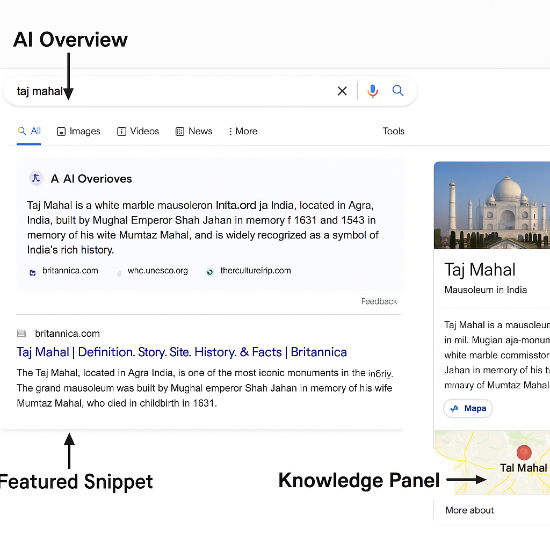 A zero-click search occurs when a user’s query is answered directly on the search engine results page (SERP) without them needing to click on any of the results on the SERP. This means the user gets the information they need—definitions, directions, facts, calculations, summaries—without ever visiting a website. These answers often come from:
- Featured Snippets (aka "position zero")
- Knowledge Panels
- People Also Ask boxes
- Weather widgets, stock tickers, and local pack results
- AI-generated summaries (such as Google's AI Overviews, launched broadly in 2024)
In essence, the search engine becomes the destination, not a gateway.
Zero-Click is on the rise
The concept of zero-click began as early as 2014, when Google introduced features like Featured Snippets and the Knowledge Graph on the search engine results page (SERP).
The Knowledge Graph was designed to help Google transition from merely matching keywords to its move towards understanding search intent. This shift allowed Google to provide more accurate and contextually relevant information. As Amit Singhal, then Senior Vice President at Google, explained:
“The Knowledge Graph enables you to search for things, people, or places that Google knows about... and instantly get information that’s relevant to your query.”
By understanding the nuances of language and the connections between entities, the Knowledge Graph aimed to deliver more precise answers, reducing the need for users to sift through multiple links.
The primary purpose of Featured Snippets is to provide users with quick, direct answers to their queries. According to Google: “Featured snippets come from web search listings. Google's automated systems determine whether a page would make a good featured snippet to highlight for a specific search request.”
This feature was introduced to enhance the search experience by delivering immediate information, especially for straightforward questions, thereby improving user satisfaction.
As you can see, in both cases, these SERP enhancements were meant to improve the user’s experience with Google’s search results.
Why Is Zero-Click Happening
There are several reasons behind the rise of zero-click searches, and all zero-click has implications for SEO:
1. User Convenience
Search engines aim to minimize friction and enhance the user experience. By answering questions instantly, users save time. For simple queries ("What’s the weather today?", "How tall is Mount Everest?"), this is efficient and expected.
2. Search Engine Business Models
Google and other engines aim to keep users on their platforms longer. The more time users spend within Google’s ecosystem, the more ads they see—and the more data Google gathers to improve targeting. This benefits their core advertising business.
3. Mobile and Voice Search
The rise of mobile usage and voice assistants (like Siri, Alexa, and Google Assistant) has further pushed the need for quick, spoken answers. These platforms often return a single, spoken result, reinforcing zero-click behavior.
4. AI and Large Language Models (LLMs)
With the arrival of AI Overviews and chat-based search (e.g., ChatGPT, Perplexity.ai), the search engine has morphed into an answer engine. These tools synthesize and summarize content across the web, reducing the need for users to dig through individual sites.
5. Changes in User Behavior
People are now conditioned to expect immediate answers. They no longer view the SERP as a table of contents, but as the content itself. This shift in behavior has prompted search engines to meet that expectation more aggressively.
AI Summaries Impact Traffic
AI-generated summaries, particularly those from Google's AI Overviews, have significantly altered user interaction with search engine results pages (SERPs), resulting in a notable decline in organic traffic to websites. This shift is primarily due to users obtaining the information they seek directly from the search results, reducing the need to click through to external sites.
SEMRush did a deep dive analysis on tens of thousands of keywords, including click-stream data from Datos, that trigger AI Overviews in the US, and found that:
- AI Overviews are on the rise, with 13.14% of all queries triggering an AI Overview. This is as of March `25. This percentage was up 6.49% from January of `25
- Informational content is most likely to trigger an AI Overview. This proved to be the case in 88.1% of queries.
- Navigational queries that triggered an AI Overview doubled since January, from 0.74% to 1.43%
- Zero-clicks, on average, are a growing behavior due to the informational nature of AI Overviews.
From Outdated Tactics to a New Paradigm
The traditional SEO toolkit, centered around keyword rankings, backlink profiles, and meta optimizations, was built for a very different digital landscape. That landscape assumed the SERP was a gateway, not the destination.
But with the emergence of zero-click results and AI-powered answers, we now live in a world where the SERP itself is often the final stop for many users.
As a result, these legacy tactics, while still valuable in certain contexts, can no longer stand alone as the foundation of a winning search strategy. Marketing professionals must adapt not only to what search engines prioritize but also to how users engage with content in an era where exploration beyond the SERP is in decline.
The shift isn’t merely tactical. It’s strategic. And it’s already underway.
The Emergence of AI-Centric SEO Strategies
 The rise of generative AI has given birth to a new SEO frontier, one that prioritizes visibility within AI-generated content as much as (or more than) traditional blue links. Whether it’s Google's AI Overviews, Bing’s Copilot results, or responses generated by AI search tools like Perplexity and ChatGPT, we are witnessing the dawn of what many are calling "Generative Engine Optimization" (GEO).
This new model demands a shift in mindset. Success is no longer defined solely by ranking on the first page of Google. Now, it’s also about influencing the information surfaced by AI tools and becoming the trusted source from which these engines draw to construct their synthesized answers.
This means developing authoritative, structured, and deeply trustworthy content that isn’t just optimized for search engines, but also designed to teach machines.
Let’s explore how these AI-centric strategies are reshaping SEO and what savvy marketers must do to stay ahead.
Generative Engine Optimization (GEO): A New Mandate
The SEO battlefield has shifted. Visibility no longer depends solely on ranking position; it hinges on whether your content is trusted enough to be summarized by AI. In this new environment, search engines are evolving into answer engines, pulling insights from across the web to create their curated responses.
This trend has led to the rise of Generative Engine Optimization (GEO), a strategic approach focused on positioning your content to be referenced by AI-powered systems, such as Google’s AI Overviews, Bing Copilot, and ChatGPT’s browsing feature.
Rather than trying to rank as the “first result,” GEO is about becoming a preferred source. That means creating content that’s not only accurate and valuable to human readers, but also clear, reliable, and structured enough for machines to parse and trust.
At its core, GEO asks a new kind of question: not “how do I get more clicks?” but “how do I become the voice AI chooses to echo?”
Structured Content is Machine-Friendly Content
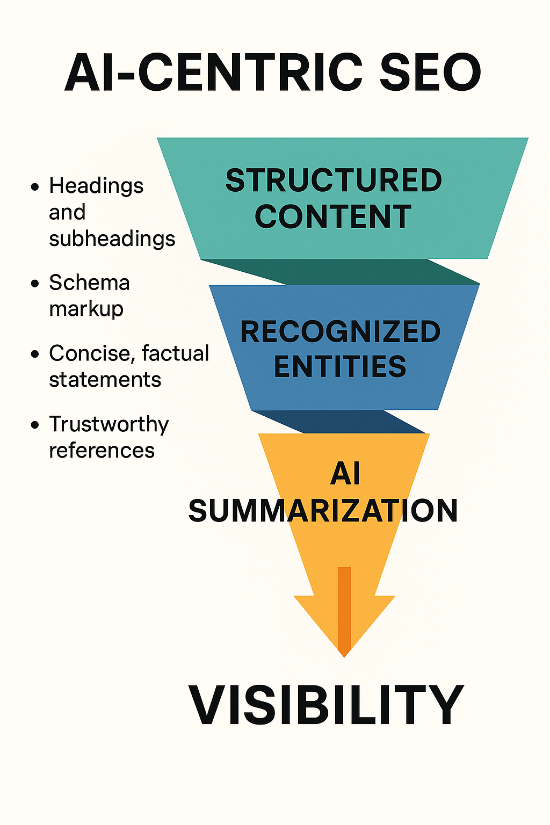
One key pillar of AI-centric SEO is structure. AI systems prefer content that is:
- Organized with subheadings and logical hierarchy
- Marked up with schema (structured data)
- Written with concise, factual statements that are easy to summarize
- Supported by trustworthy references and external links
Content that reads well for humans must now also be easily digestible by machines. This means optimizing beyond readability and focusing on scannability, enabling LLMs (large language models) to extract facts, context, and authority signals efficiently
Topical Authority Over Keyword Stuffing
In an AI-driven world, search engines and LLMs lean toward topic authority over exact match keywords. Instead of trying to game the algorithm with keyword variations, savvy marketers are developing comprehensive content hubs centered on core themes. These hubs signal depth, expertise, and trustworthiness, precisely what generative engines seek when assembling summaries or responses.
As a result, being the best single article on a narrow topic is no longer enough. You need to be the most consistent, in-depth voice across an entire domain.
This is why content clusters, pillar pages, and semantic relevance matter more than ever.
Entity-Based Optimization: Establishing Context and Credibility
One of the most significant shifts in modern SEO, particularly within AI-powered environments, is the transition from keyword-based optimization to entity-based optimization.
Entity-based optimization means focusing your SEO strategy around clearly defined, recognizable concepts (called “entities”), such as people, companies, places, products, or ideas, that search engines and AI models understand as distinct topics. Google, Bing, and AI tools like ChatGPT no longer simply look for keyword matches; they attempt to understand the relationships between entities and how they fit into the broader context of a user’s query.
For example, “Albert Einstein” is not just a string of characters—it’s an entity with attributes (physicist, Theory of Relativity, Nobel Prize, etc.). When AI models encounter your content, they attempt to associate it with entities like these to determine its relevance, accuracy, and authority.
To optimize for this, your brand needs to become closely associated with specific entities that you want to be known for. That means:
- Writing content that consistently focuses on key subject areas
- Using structured data (schema markup) to define what or who your content is about explicitly
- Linking to authoritative sources that are already tied to those entities
- Including clear, well-structured bios for authors and pages like “About Us” that explain your domain of expertise
In short, entity-based optimization helps AI and search engines connect the dots between your content and the topics you want to lead on.
If you’re not building those associations clearly and consistently, you risk being ignored, not just by users, but by the very AI systems shaping what those users see.
Summary:
This article examines how traditional SEO practices, which focus on keyword rankings and driving clicks, are becoming outdated in an increasingly AI-dominated search landscape.
With the rise of zero-click searches, features like featured snippets, knowledge panels, and, most notably, Google’s AI Overviews, users are increasingly finding answers directly on the search engine results page (SERP) without ever visiting a website. This shift has significantly reduced organic traffic, particularly for informational queries. It reflects a broader trend in which the SERP has evolved from a gateway to the final destination for user queries.
To stay relevant, SEO strategy must evolve from reactive to proactive. This means embracing Generative Engine Optimization (GEO), a forward-thinking approach that focuses on creating content that is trustworthy, well-structured, and recognizable by AI systems.
Rather than chasing rankings, modern SEO aims to become the source that AI models cite and summarize for their information. Key tactics include optimizing for entity recognition, building topical authority, and structuring content for both human readability and machine understanding.
The future of search isn't about being the top result—it's about being the most trusted source in an AI-driven ecosystem.