If you’ve worked in marketing or sales for any length of time, you know the tension that always seems to pop up: marketing is generating leads, but sales says, “they’re not ready yet.” On the flip side, marketing feels like they’re doing their job filling the funnel, but then watches those same leads stall or disappear once they hit sales.
Sound familiar?
It’s a frustrating cycle. Leads go cold, salespeople feel like they’re wasting time, and marketing teams wonder if the effort was even worth it. But what if the problem isn’t the number of leads at all, what if it’s how they’re nurtured?
Recently, I was reading an industry marketing journal and ran across a study that really caught my attention. The researchers looked specifically at automated lead nurturing and its impact on sales. What stood out to me was how clearly the evidence showed that when you use automation to nurture leads, you don’t just save time, you actually improve the quality of conversations your sales team has and increase the odds of converting leads into customers.
That finding stopped me in my tracks. And it confirmed something I’ve seen firsthand working with clients: automation isn’t just a “nice-to-have” tool, it’s a real driver of revenue when it’s done right.
What Automated Lead Nurturing Really Means
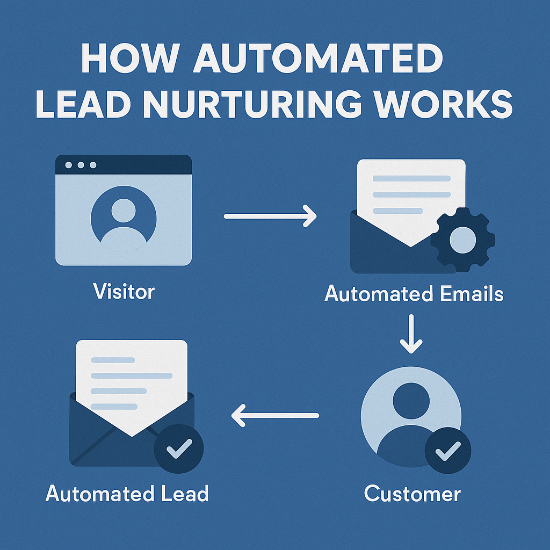 Let’s strip away the jargon. Automated lead nurturing is simply using technology to send timely, personalized messages to prospects based on what they’re actually doing. It’s not about blasting everyone with the same generic newsletter or having your sales team cold call a list that barely engaged. It’s about responding to behavior in real time.
Here’s an example. Let’s say a prospect downloads a white paper or a guide from your website. A couple of days later, they come back and read a case study. With automated nurturing in place, that behavior triggers a sequence designed to meet them exactly where they are in the buyer’s journey.
They might get an email with a webinar invitation that goes deeper into the same topic. When they click, your sales team gets notified, not just that they clicked, but that they’ve read a white paper, explored a case study, and now watched a webinar.
Compare that to the old way, where the same person would just get tossed into a generic drip campaign or handed off cold to sales. The difference is night and day.
Platforms like SharpSpring from Constant Contact make this possible by combining a customer relationship management (CRM) platform and a marketing automation platform all in one system. That means all of your lead interactions, emails, downloads, page visits, and form fills get tracked in one place. Sales sees the same data as marketing. And automation takes care of the repetitive touches that keep leads warm while sales focuses on real conversations.
What the Research Found
Now, back to the research I mentioned. The team behind the study didn’t just speculate; they dug deep with three quantitative studies and a series of interviews to see if automation really moved the needle in sales. Here’s what they discovered:
- First, automation boosted high-quality interactions. Sales teams weren’t just making more calls; they were having more meaningful conversations. Leads nurtured with automation were more likely to schedule meetings or engage in deeper discussions rather than surface-level exchanges.
- Second, conversion rates improved. Leads that went through automated nurturing before getting to sales were more likely to turn into real opportunities and ultimately customers.
- Third, automation gave sales better information. Because reps could see which emails a prospect opened, what content they consumed, and what actions they took, they were better equipped to personalize conversations. No more guessing games.
- Ultimately, they discovered that automation works best in complex sales cycles. If you’re selling something simple and transactional, the lift isn’t as dramatic. But if you’re in the B2B world with longer sales cycles and multiple decision-makers, automated nurturing gives you a serious advantage.
Reading this, I thought: this is exactly what I’ve seen play out with clients. Automation creates alignment, it gives sales better tools, and it prevents leads from slipping through the cracks.
Why This Matters for Your Business
Here’s the reality: not all leads are ready to buy right now. In fact, most aren’t. Some are just starting to explore possible solutions to their problem. Some are gathering information. Others are comparing options. If you hand those leads straight to sales, odds are they won’t go anywhere.
But if you nurture them with content and communication tailored to their stage, they’re far more likely to move forward. By the time they reach sales, they’re educated, engaged, and much more willing to have a real conversation.
This matters for three big reasons:
- You’ve already paid to generate those leads. Letting them go cold is like lighting money on fire.
- Automation provides sales and marketing with a shared process and a shared set of data, which reduces finger-pointing.
- Once you set it up, automation works at scale. You don’t need a bigger team to nurture hundreds or thousands of leads—it all runs in the background while your team focuses on strategy and closing deals.
In other words, automation isn’t just efficient, it’s effective.
How SharpSpring Puts It Into Action
All of this sounds great in theory, but how do you actually make it happen? That’s where a platform like SharpSpring comes in.
Here’s what I love about SharpSpring: it’s not just a CRM, and it’s not just a marketing automation tool; it’s both. Everything lives in one place. So when marketing builds out a nurturing sequence, sales can see every single interaction a lead has had with it.
For example, if a lead visits your pricing page three times in a week, SharpSpring can automatically increase their “lead score,” putting them higher in the qualification process, flag them as sales-ready, and notify your sales rep.
On the flip side, if a lead is just starting out, downloading an introductory guide, reading a blog post, they’ll get nurtured with educational content until their actions signal they’re ready for more.
This is exactly what the research showed: when sales has the right information and marketing keeps leads engaged, the handoff is smoother and conversion rates go up.
And this isn’t just about the technology, it’s about having the right partner to implement and optimize it. That’s where we come in. We don’t just resell SharpSpring; we help our clients set it up in a way that aligns with their business, their sales cycle, and their goals.
Putting It All Together
Here’s the big takeaway. Automated lead nurturing isn’t just a buzzword. It’s not a shiny add-on you may or may not use. The research proves it’s a powerful driver of real results, better conversations, higher conversions, and a more efficient pipeline.
Without it, you risk losing too many of the leads you’ve already worked hard to generate. With it, you give yourself a system for building stronger relationships and ultimately driving more revenue.
That’s why I’m convinced automated nurturing is the missing link in so many sales pipelines. And with SharpSpring, it’s easier than ever to put into practice.
Final Thoughts
The divide between sales and marketing has been around forever. But it doesn’t have to be this way. Automated lead nurturing bridges that gap by making sure leads get the right communication at the right time, and sales steps in when the lead is ready for a real conversation.
The marketing journal that I read confirmed it with data. I’ve seen it confirmed in the work we do with clients. And if you’re ready to stop letting good leads slip away, I’d encourage you to see what it can do for your business too.
If you want to explore how this could work in your pipeline, let’s talk. We’d love to show you how SharpSpring can help you nurture more leads, align your teams, and close more deals.