A recent white paper I ran across took a little different twist on how B2B companies and salespeople can use social media to generate more sales leads, that I thought was pretty interesting. The strategy is called social selling. No, this is not social media marketing. Social selling is using both marketing and sales strategies to help companies generate more quality sales leads.
Social selling is all about using the right social media platforms (social platforms that your audience frequents) to find prospective customers that fit your ideal client profile (ICP) and begin to engage with them with conversations that will provide them with the correct information at the right time.
Social selling is unique from social media marketing in that social marketing attempts to engage many people aiming, in most cases, to increase the visibility of their brand or to promote a product or service.
On the other hand, social selling attempts to engage on a one-to-one level with focused "conversations" with the appropriate people within an account by using highly relevant content.
Social Selling Is Important Because…
B2C companies have been using social media platforms to sell for a couple years and contrary to many opinions, B2C companies do not use social channels to push a quick sale. B2C companies are using a social selling strategy to build relationships, build brand visibility and have conversations with their customers. These are the exact same goals that B2B companies have. However, B2B companies have been reluctant to use social media platforms for selling. B2B companies can use this same strategy to increase brand visibility and lead generation.
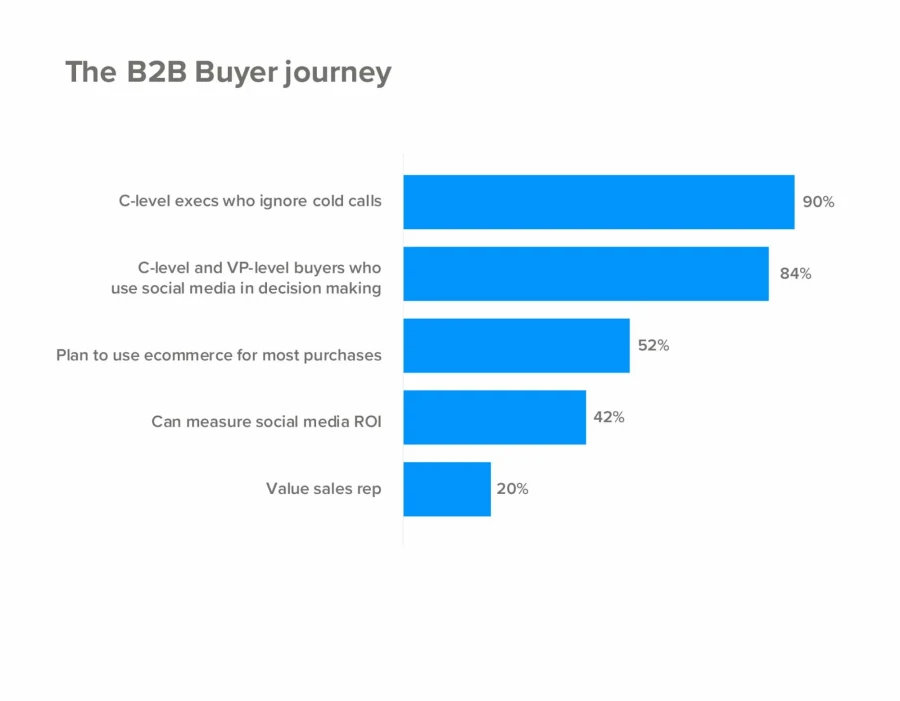 There is reporting that shows 75% of B2B buyers and 84% of C-Level/VP executives use social media to make purchase decisions.
LinkedIn discovered that 45% more opportunities are uncovered by using social selling, social selling leaders are 51% more likely to reach their quota, and 78% of social sellers outsell their peers.
Now, all of these stats are excellent information. However, the most important reason you should consider social selling as a strategy is that it is one of the best methods to engage prospects for the long-term that is today's B2B selling environment.
You don't have to look far to find an article about how the B2B sell cycle is getting longer and that more people are involved in the buying process than ever before.
Because of these changes in buyer's processes, social selling is the perfect strategy for connecting with multiple buyers from a company that could be involved in the buying decision and engaging with them over the long term so that you're able to provide them with information while they move through their buying process.
Another advantage to social selling is that it gives you the opportunity to build trust among your prospects, and trust is an increasingly critical component of how buyers. A Salesforce survey among 8,000 buyers found
- 84% of customers say that the buying experience is worth more to them than the service or product purchased
- 65% of customers stop working with brands because of a loss of trust.
- 73% of customers say that a company's trustworthiness matters more than it did a year ago.
The role of salespeople is continually evolving as more business buyers complete more of their buying processes online.
It wasn't that long ago that salespeople could build relationships and trust with clients and prospects via in-person sales calls. As the buyer's preferences have evolved, in large part due to the pandemic, the salesperson's ability to get in front of buyers has drastically changed, and they are now faced with trying to build that trust online.
Setting Up Your Social Selling Strategy
When you begin setting up your social selling strategy, the first and possibly most important step is to clearly identify the personas of your ideal client. There are thousands of articles available that define precisely what a persona is and how to create them, so we're not going to go into the development of personas here.
A well-developed persona will assist you in identifying the type of information your buyers are interested in so you can deliver relevant information. It will also help you narrow down the social media platforms they are most likely to frequent.
The top three social media platforms for B2B social selling are LinkedIn, FaceBook, and Twitter, and each of these should be used uniquely.
Because LinkedIn is specifically a business-focused social media platform, it is our opinion that every B2B company should view LinkedIn as a priority for both social media marketing and social selling. LinkedIn users are highly engaged and extremely active.
LinkedIn has many filters that can be used to find the people that will make up the personas you are looking for. To name a couple, you can filter by things like a person's position, company geography, and even company revenue.
To succeed at social selling on LinkedIn here are some strategies that have proven successful:
- Salespeople should have their own unique and separate profile from their company's profile.
- Your LinkedIn profile should demonstrate how you help customers, similar to the prospects you are trying to get to your LinkedIn page.
- Your LinkedIn summary should be no longer than two paragraphs. In this paragraph, you should describe your role at your company and the unique value proposition you and your company provide. This is an excellent place to let your personality shine and let people know why you do what you do.
Still the undisputed king of social media platforms, it would be counter-productive to ignore it, even though it typically has a more consumer focus. It's essential to recognize that B2B buyers are people too and will spend some of their time on FaceBook, even if it's all for non-business-related activities.
We all know that FaceBook has devalued business profiles, so the first step in using FB for social selling is for salespeople to establish their personal profile page. Because there are a vast number of business-related groups within FB, using this platform for prospecting can yield some positive results.
Some of the strategies for success on FB are
- Boost your company's content. Even though businesses aren't held in high regard on FB, you should still have a company profile and post to that profile; however, to increase reach, encouraging salespeople to share your posts will get you better visibility.
- Participate in the groups relevant to the industry you sell to. This is a great way to build your brand, be recognized as a thought leader, and build business relationships with people who make up your ideal client profile.
- Being visual on FB is extremely important. Image and video content gets the most engagement on this platform. Put in the effort to convert some of your written content into video format and watch your FB engagement take off.
Twitter is a very immediate platform designed for quick thoughts, news, and content. Twitter lacks the transparency of LinkedIn as users do not have to share their real identities making this platform more difficult to find the individual people that you might be targeting.
The best way to find people that could become prospects on this platform is to identify hashtags used by your target audience and start to follow people who use those hashtags frequently. Once you can find people using the appropriate hashtags, you are better enabled to begin engaging in those conversations and begin building relationships among these people.
Conclusion
Social media platforms are great for marketing but even better for social selling. It can be a bit of work getting started with social selling, but in the end, it's an excellent strategy for targeting prospects and using the long game to cultivate future sales.