SEO is one of the most important digital marketing channels while also being one of the most frustrating digital marketing channels. The work involved in organic optimization can feel like a lot of smoke and mirrors, and it isn’t easy, at best, to know what to do and what not to do. Unfortunately, doing SEO wrong can have devastating and lasting consequences for your website and company.
We've put together this article on 5 Common SEO Mistakes to better understand SEO.
SEO Mistake #1: Too Little Content.
Let’s start talking about the amount of content on a web page by clarifying that the amount of content on your website’s pages is not a ranking signal. That’s not to say that the content on your site won’t impact your SEO ranking because it’s impossible to rank a website page without content.
The search engines use a website’s content to understand what the page is all about. Search engines perform best when they deliver highly relevant results to the query that the user typed into the search box. To do that, they need to fully comprehend what your website pages are all about.
So, though the quantity of words on your website page is not a ranking factor, it does take a quantity of words to explain your company, product, or service and establish you as an expert on that information.
We've put together this article on 5 Common SEO Mistakes to better understand SEO. When that happens, their content often reads like a 6th grader’s book report. They're stuffing words into the content just to hit a word count, and that stuffing brings nothing of value to either the reader or the SEO effort.
SEO Mistake #2:Technical SEO
The mistake many marketers make when it comes to technical SEO is not paying any or enough attention to the technical side of SEO. You could do fantastic work in researching the keywords that are important to your website’s page, write fantastic content including those keywords, and provide fantastic value to the people reading that content. However, if the technical side of your website page has not been optimized, all that fantastic work you’ve done will be for nothing.

Technical SEO is the work that is required to make sure that the search engines can crawl, index, and understand what your website page is all about. Technical SEO is indeed a component of on-page SEO. However, it is often overlooked.
Here are some of the elements that need to be addressed when you’re optimizing the technical side of your website page:
Robots.txt: There is a file, or should be, in your website’s structure called “robots.txt”. This file tells the search engine's bot which pages on your site it can access. Some of the primary things that should be handled within the robots.txt file from an SEO perspective are:
Make sure pages you want indexed and ranked aren’t blocked from the search engine’s bots.
Use the robots.txt file to tell the bots not to crawl the pages within your website that aren’t intended to be displayed to the public. For example, if your website has a content management system (cms), you could include your CMS login page so that it doesn’t appear in the search engine results.
Suppose you have gated content that users have to submit a form to get, generally, after submitting the information to get the content (often a white paper). In that case, the user will be taken to a “thank you” page where they can download the content. In these cases, you’d want to put the URL of your thank you page in the robot.txt file for bots to not crawl those pages because if your thank you page shows up in search results, there’s no reason for people to give their name and email to get your gated content.
This file is essential to your site and your company, so don’t just start changing it without knowing what you’re doing and any repercussions you may experience as a result of your changes.
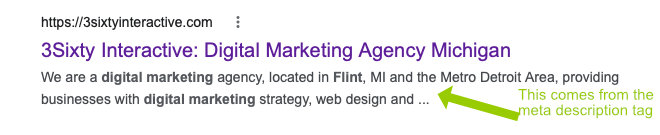 Meta Description Tag: The description tag is what the search engines use for the content under the title of a search engine result listing.
If you don't fill in the meta description tag, the search engines will pull some random content from your page that may not be relevant enough to entice someone to click through to your website.
By filling in this information, you control what goes here and can use a powerful call to action to get more people to click on your search listing.
XML Sitemap: The XML sitemap is a file that is contained within your website's structure that tells the search engine bots about the pages within your website. A good sitemap will provide bots with a roadmap of all of the important pages on your site along with the structure of your website, making it easier for bots to crawl your website.
One of the best ways to make sure that the search engine bots can find your XML sitemap file is to reference it in your robots.txt file.
Site Speed: The speed of your website is a ranking signal, meaning that website pages that load faster will be ranked ahead of pages that are slower, when all other ranking signals are the same. This became a ranking signal as a result of Google's focus on the user's experience on websites.
Site speed is measured by the time it takes for a website page to load after a user clicks on a link or enters the page's URL. There are a number of factors that are measured to determine a website's page speed which we covered in this blog post.
To find out how your site measures up, here's a link to Google's tool that measures page speed.
SEO Mistake #3:Social Media
Just like the word count of content, social media has no direct ranking signals; however, the results that marketers get from social media will have an impact on other digital marketing activities that do have an impact on ranking signals.
Here’s an example. Social media posts that garner interest among its readers will drive the reader to your website, generating traffic to your site. This traffic to your site will impact the behavioral characteristics of your site, and those behavioral characteristics are a ranking signal.
Then there’s the link between your social media posts and the shares that you get from those posts. Again, shares are not a ranking signal, but the more often your post gets shared defines that post as having high value. Research by CognitiveSEO found that there is an equivocal link between social shares and SEO.
So, the biggest SEO mistake when it comes to social media is not to use social media.
SEO Mistake #4: Local SEO
Ok, so not technically SEO; the reason that we included LocalSEO in this list is that all too often, companies that do business locally completely forget to optimize for LocalSEO. Local optimization is essential as Google tells us that 46% of all searches are looking for local information.
LocalSEO is work done on a website that will improve the search results for companies that want to show up for search queries that are indicating a geographical location. These queries can be “near me” or specific cities or states.
The first step for optimizing local SEO is opening a Google My Business account. Within this tool, you will be able to list all the information that people need when searching for what you do or sell. You’ll be able to list your company name, address, phone, hours of operation, link to your website, and more.
However, the most important part of GMB is the part that most people forget or ignore: the social media component. Within GMB, you can post articles just like on your social media profiles.
There is a lot to GMB, and Hubspot has written a pretty comprehensive article on how to use it. Here’s a link.
SEO Mistake #5: Backlink Quality of Quantity
Rounding out our top 5 SEO Mistakes is backlinks. Backlinks are vital for SEO because they are a “vote” that your content is important. The search engines then view that vote as demonstrating that your content should be ranked above similar content that doesn’t have backlinks.
The age-old question when it comes to backlinks is quantity or quality. Do you want as many backlinks as possible for a website page or blog article, regardless of the site that is linking to your page, or do you only want to get links from “quality” websites?
Let’s start this conversation by identifying what a “quality” website is. As you would expect, a quality website might be a site like Forbes, NY Times, or maybe ESPN. However, for most companies, getting a link from one of these sites is nearly impossible, but that doesn’t mean there aren’t quality sites out there that you could get backlinks from. The trick is finding them and knowing if they’re a quality site in the eye of the search engines.
There is a ranking system for website quality that several different SEO tools use that is very helpful. Moz uses the Doman Authority (DA) ranking system that they developed. SEMRush uses a similar ranking, and AHREF also has a website authority checker.
It doesn’t matter which tool you use as much as it matters that you use something to find quality websites to build your backlinks from.
So, back to the original question, is it better to build a large quantity of backlinks or a few quality backlinks.
It’s, unfortunately, not an easy question to answer as each has pros and cons. Let’s review some of the pros and cons of quantity and quality backlinks.
High-Quality Backlinks
Some of the pros to high-quality backlinks are:
- High-quality backlinks come from websites with high domain authority rankings, which means that backlinks from these sources will not negatively impact your DA ranking, nor will they hurt your SEO rankings.
- Quality backlinks will more than likely send a higher quality visitor to your site because they have…well, higher quality people visiting their websites.
- Quality backlinks will also help your SEO rankings because search engines place a higher value on quality backlinks.
Cons to high-quality backlinks are:
- They are hard to get. Think about how hard and long it would take to get a backlink from Forbes or ESPN! You have to decide if you’re willing to put in the effort to generate backlinks from websites that have the highest domain authority.
High Quantity Backlinks
Let’s first identify what to look for when going after a high quantity of backlinks. Regardless of how quickly you want to build your backlinks, you always want to stay away from spammy websites for backlinks. These will do you no good in improving your SEO rankings and will certainly hurt your rankings.
For high quantity rankings, you’re going to focus on websites with a DA somewhere in the middle of the pack. DA rankings from around 40 -70 are good targets.
It’s, unfortunately, not an easy question to answer as each has pros and cons. Let’s review some of the pros and cons of quantity and quality backlinks.
Pros to high-quality backlinks are:
- The most obvious is that they are relatively easy to get, and the more links you have from mid-to-high level DA websites, the better.
Some of the cons to high-quality backlinks are:
- You risk getting backlinks from spammy websites, hurting your SEO ranking efforts.
- As high-quality links will drive high-quality visitors, low-quality links will drive low-quality visitors, and though that may not be hurting your rankings, it will certainly not help you grow your business.
- Just like your mother told you, you are who you associate with; many spammy backlinks coming to your site will make the search engines think that your site is a spammy site, hurting your SEO ranking efforts.
In the end, just like with everything else, it’s best to have your backlinking efforts move away from one extreme or the other and walk down the middle, trying to get a little quantity and a little quality for your backlinks.
Conclusion
We hope that this information will help you with your SEO efforts. If we can leave you with one thought on SEO, we’d like to say that the worst mistake anyone can make when it comes to SEO is to think that it is a one-and-done activity. Search engine algorithms are changing all the time, and every change brings the potential to remove one of your website pages from its current ranking position.