In a world where marketing channels keep multiplying, and the pressure to deliver results only intensifies, it’s easy to feel outpaced by competitors who have massive budgets, large teams, and endless content pipelines. Yet the real advantage isn’t necessarily scale. The real advantage is strategy.
If your marketing team is operating on restricted budgets, with limited headcount, and you’re looking to make an outsized impact in search, then you don’t win by doing more. You win by doing the right things, the right way, aligned to your business. That’s where a strong SEO strategy comes in.
Why Bigger Teams Don’t Automatically Win SEO
It might seem logical that the company with 20 content creators, 10 SEO specialists, and an unlimited budget should dominate organic search. In practice, however, that’s not always true.
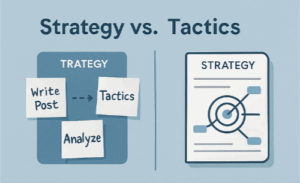 Large marketing teams often fall into the trap of working in silos or focusing solely on tactics. SEO becomes a to-do list for junior team members, often times completly disconnected from business goals. Content is pushed out in volume rather than crafted for purpose. And when results don’t show up immediately, frustration sets in.
Contrast that with smaller, tighter teams that align the SEO function directly with business outcomes. They prioritize what matters, move quickly, and avoid getting bogged down in low-impact tasks. Scale helps, but clarity and focus beat scale when resources are limited.
The Strategic Advantage Lean Teams Have: Focus
When resources are constrained, you naturally prioritize. That’s a strategic advantage.
Instead of trying to cover every possible keyword, every blog topic, and chase every backlink opportunity, you pick your lane. You focus on search queries, content, and technical fixes that directly map to business value. You build a roadmap you can actually execute. You move faster.
When your competitors are busy chasing volume and every metric they can find, you move with precision. You know your goals, your constraints, and what will move the needle.
Step 1 – Ground Every SEO Decision in Business Goals
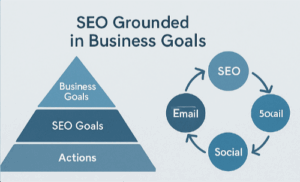 Any strategy worth its salt starts with business outcomes, not keyword lists. If you begin with “we want to rank for X,” you’re setting yourself up for tactical work without purpose.
Define what success will look like for your business. Are there more qualified leads through organic search? Is it a higher conversion rate from organic traffic? Is it reducing the cost of paid acquisition by picking up more pipeline through SEO? According to a recent guide from Search Engine Journal, aligning SEO with business goals and identifying KPIs is the first and essential step in building a winning strategy.
When your SEO goals are tied to the broader marketing or sales goals, then every decision becomes easier. You can evaluate “does this activity support the business outcome we care about?” That alignment will save you time, budget, and internal frustration.
Step 2 – Identify High-Impact Opportunities Instead of Doing Everything
With limited resources, you cannot do everything. What you can do is identify what matters most.
Start by looking at the pages that already carry business value, product or service pages, pages tied to revenue, and high-intent keywords. Next, look for gaps in competitor content. Then check for technical or UX issues that are blocking conversions.
By focusing on the highest-impact opportunities, you accelerate results. A recent article recommended that marketing teams build a roadmap with priorities structured around business objectives, technical backlog, and content strategy.
This means you’re not simply adding blog posts for the sake of blog posts. You’re targeting queries and pages that feed the funnel, that have a measurable impact.
Step 3 – Build a Lean SEO Roadmap You Can Actually Execute
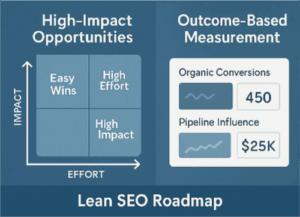 Once you’ve defined your goals and prioritized your opportunities, you need a roadmap, a plan that your team can follow and stick to.
This roadmap should break your strategy into manageable windows (for example, quarterly), and should include technical fixes (crawlability, indexing, mobile performance), content projects (focusing on high-intent pages and topic clusters), and authority building (link or mention acquisition). The key is that you set realistic timelines and responsibilities.
Too many strategies die in the “planning” phase or crumble because they try to do everything at once. Search Engine Journal talks about the importance of an SEO roadmap, noting that teams often fall short because they lack structure and discipline.
When your roadmap is lean, clear, and aligned with your objectives, you reduce wasted work and ensure progress.
Step 4 – Integrate SEO Across the Marketing Engine
SEO shouldn’t live in its own bubble. For lean teams especially, the biggest wins happen when SEO is integrated into broader marketing and product workflows.
Use SEO data to inform content calendars. Use keyword research insights to shape paid search or social campaigns. Let UX and product teams know what search queries uncover so your website architecture matches user intent. When SEO, paid, social, email, and product teams collaborate, the result is amplification rather than duplication.
Because when SEO is siloed, you end up with content nobody sees, backlinks that go nowhere, and fragmented effort. Integration makes every channel smarter.
Step 5 – Measure Outcomes, Not Just Rankings
Ranking on page 1 is nice, but by itself it doesn’t pay the bills. Lean teams win when they measure business outcomes driven by SEO.
Instead of tracking how many keywords you’re ranking for, monitor how many organic-search visitors convert, how many leads originate from organic, and how much paid search spend you saved because organic picked up the load.
When you speak the language of your executives, leads, revenue, and cost‐per‐acquisition, you build confidence in SEO and justify budgets.
Step 6 – Continuously Refresh the Strategy
Search engines change. User behaviour changes. Your business changes. A static SEO plan is a road to stagnation.
Within your roadmap, you must build checkpoints. Quarterly or semi‐annual review points to ask: Are we hitting our goals? Has our business focus shifted? Has search behaviour shifted? From emerging AI search assistants to new SERP formats, the environment isn’t fixed.
One article warned that many teams treat SEO as a checklist and then blame “SEO doesn’t work” when the landscape has moved on.
By embedding reflection and adaptation, you make your strategy robust and future-proof.
Conclusion – Strategy Is the Great Equaliser
When a marketing team operates with limited resources, the difference between being overshadowed and standing out has nothing to do with staff size or budget. It comes down to the strength of the strategy behind the work. Clear priorities, meaningful goals, and a focused roadmap will outperform scattered tactics every time.
If your SEO efforts feel busy but not effective, this is the moment to pause and evaluate whether your actions align with your business objectives. Ask yourself if the work you’re doing is truly connected to outcomes, or if you’ve slipped into a cycle of checking boxes without moving the needle. If you’re not sure, that’s a signal to step back and build a smarter, more intentional strategy.
If you want more information on creating an SEO strategy that delivers measurable results, reach out and start a conversation with us. We can help you understand what’s working, what’s holding you back, and what needs to change so you can turn SEO into a reliable growth engine for your marketing.