For years, marketing leaders have debated whether Return on Ad Spend (ROAS) or Return on Investment (ROI) is the “right” metric for measuring marketing success. In many organizations, this debate plays out in budget meetings, performance reviews, and quarterly planning sessions, often without resolution.
The issue isn’t that one metric is better than the other. The issue is that they’re frequently expected to answer the same questions.
They can’t. And they weren’t designed to.
Mature marketing teams understand that ROAS and ROI serve different roles, operate at different levels, and inform different types of decisions. When used together, intentionally and correctly, they provide clarity rather than conflict.
What ROAS Measures and Why It’s a Channel Metric
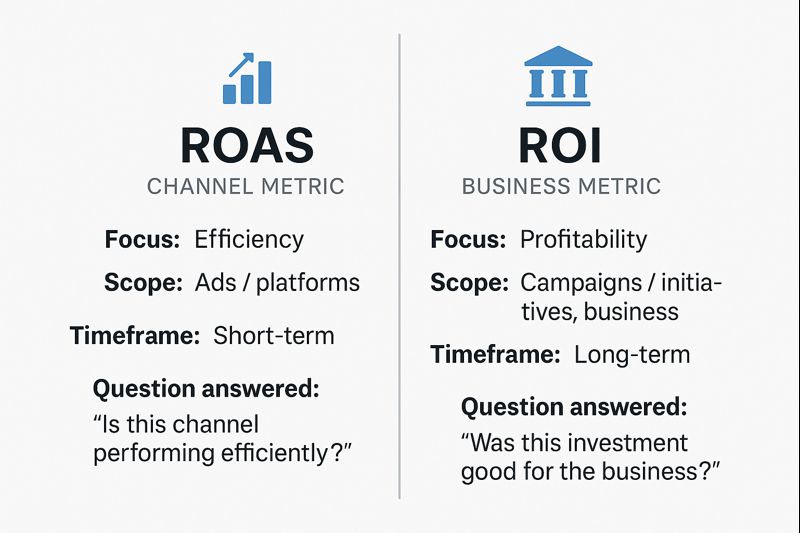 ROAS, or Return on Ad Spend, measures how much revenue is generated for every dollar spent on advertising. At its core, ROAS is a measure of efficiency.
Because of how it’s calculated and where the data comes from, ROAS naturally lives at the ad channel level. It’s pulled from advertising platforms and attribution systems designed to evaluate performance across specific environments such as paid search, paid social, display advertising, and other media channels.
ROAS excels at answering questions like:
- Which campaigns are performing better than others?
-
Which audiences or keywords deserve more budget?
-
Which creative variations are driving stronger results?
This makes ROAS invaluable for optimization. It helps marketing teams fine-tune ad execution, improve efficiency, and make informed tactical decisions quickly.
What ROAS does not do is account for:
- Sales and operational costs
- Fulfillment and service delivery expenses
- Internal labor or overhead
- Long-term customer value
In other words, ROAS can tell you whether a channel is performing efficiently, but it cannot tell you whether the business is actually benefiting.
That limitation isn’t a flaw. It’s simply the boundary of what ROAS is designed to measure.
What ROI Measures and Why It’s a Business Metric
ROI, or Return on Investment, operates at a higher level. It looks at the relationship between total costs and total return, with profitability as the central concern.
Unlike ROAS, ROI is not tied to any single channel or platform. It’s a business metric, designed to evaluate whether an investment, marketing or otherwise, was worth making.
ROI is well-suited to questions such as:
-
Did this initiative generate meaningful business impact?
-
Was the investment justified relative to its cost?
-
Should we scale, sustain, or rethink this effort?
Because ROI accounts for broader costs and outcomes, it’s essential for:
-
Budget allocation
-
Strategic planning
-
Executive reporting
-
Long-term decision-making
ROI is often misunderstood in marketing because it’s sometimes expected to function like a performance metric—fast, precise, and channel-specific. In reality, ROI is inherently slower and more holistic. Attribution helps identify which efforts influenced an outcome, even when it can’t pinpoint a single, exact cause.
That doesn’t make ROI less valuable. It makes it indispensable for leadership-level decisions.
Why Marketing Leaders Need Both Metrics
 Problems arise when organizations rely too heavily on a single metric at the expense of others.
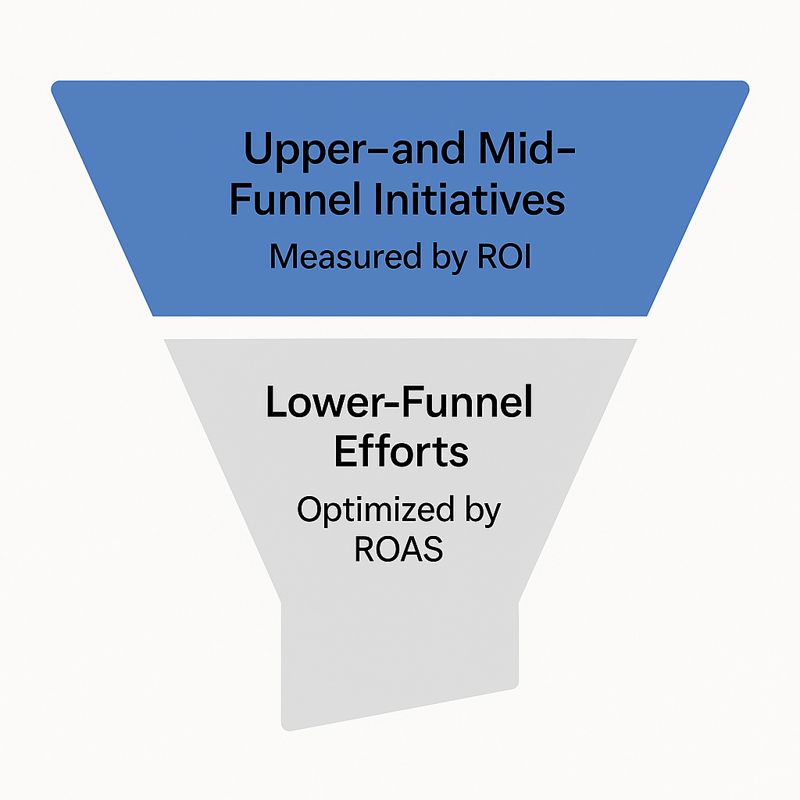
When ROAS becomes the primary measure of success, marketing efforts tend to skew toward short-term efficiency. Lower-funnel campaigns are prioritized, while initiatives that build demand, educate the market, or strengthen brand position—efforts that should be measured by ROI—struggle to justify their value, even when they’re critical to long-term growth.
On the other hand, when ROI is the only lens used, marketing teams lose visibility into how performance is being driven. Optimization slows, execution becomes less precise, and opportunities for improvement are harder to identify.
The reality is this:
ROAS and ROI answer different questions, and both questions matter.
ROAS supports execution.
ROI supports direction.
How Mature Teams Use ROAS in Practice
Experienced marketing teams treat ROAS as what it is: a channel-level optimization tool.
ROAS lives inside advertising platforms and performance dashboards, where it’s used to:
-
Compare campaigns and creative variations
-
Identify efficiency trends
-
Inform short-term budget adjustments within channels
They rely on ROAS to guide day-to-day and week-to-week decisions, not to determine whether marketing is “working” overall.
For example, a B2C brand running paid social campaigns may use ROAS to evaluate which creative concepts are driving the most efficient revenue. That insight helps improve performance within the channel, but it doesn’t, by itself, determine whether paid social deserves a larger share of the overall marketing budget.
That decision requires a different lens.
How Marketing Teams Use ROI in Practice
ROI comes into play at the initiative and business level.
Marketing leaders use ROI to evaluate:
-
Campaign groups and programs
-
Product or service-level marketing investments
-
Broader growth initiatives
This is where marketing performance is assessed in context, alongside costs, margins, and long-term impact.
Consider a B2B organization investing in a demand generation program. Early ROAS may be modest, particularly if the sales cycle is long or the program emphasizes education over immediate conversion. But when pipeline contribution and closed revenue are evaluated over time, the ROI tells a different—and more meaningful—story.
ROI informs whether an initiative should be expanded, refined, or sunset. It’s the metric that aligns marketing with financial and executive leadership.
How ROAS and ROI Work Together in Mature Organizations
The most effective marketing teams don’t choose between ROAS and ROI. They align them.
A simple way to think about the relationship is this:
ROAS optimizes performance. ROI validates the investment.
ROAS helps teams improve their channel performance.
ROI determines whether those marketing channels, and the initiatives behind them, deserve continued or increased investment.
This alignment prevents common pitfalls, such as:
-
Cutting programs too early because they don’t show immediate efficiency
-
Scaling channels that look strong in-platform but underperform at the business level
-
Creating friction between marketing, finance, and leadership teams
When ROAS and ROI are used together, marketing decisions become both smarter and more defensible.
To make this framework more practical, we’ve created a downloadable ROAS and ROI calculator that allows you to evaluate channel efficiency and business impact side by side. It’s designed to support exactly this kind of decision-making—using ROAS for optimization and ROI for evaluation—without forcing one metric to do the work of the other.
Measuring Success Across the Funnel
Not every marketing initiative should be optimized or measured the same way.
Lower-funnel efforts, where intent is high and attribution is clearer, can often be optimized effectively using ROAS. Upper- and mid-funnel initiatives, however, require a broader perspective. Their value is better understood through ROI, which takes into account long-term influence and cumulative impact.
Marketing leadership maturity shows up in the ability to apply the right metric to the right decision, rather than forcing a single measure to do all the work.
Stop Choosing a Side
ROAS and ROI were never meant to compete with each other. They exist to answer different questions, at different levels, for different decisions.
ROAS helps marketing teams optimize performance inside channels. ROI helps marketing leaders determine whether those efforts are advancing the business. When one is forced to do the job of the other, the result is confusion, misalignment, and short-term decision-making.
The most effective marketing leaders understand this distinction. They don’t ask which metric is better. They ask which metric is most appropriate for the decision at hand and build their measurement approach accordingly.
If you’re thinking through how to align performance metrics with business outcomes better, or questioning whether your current reporting is truly supporting smarter decisions, those are the right questions to be asking—and they’re worth exploring in more depth.
If you’d like help pressure-testing how ROAS and ROI are being used across your marketing efforts, or want to talk through how to apply this framework to your organization, feel free to reach out. We’re always happy to have the conversation.