While scanning headlines over morning coffee I stumbled on a notice from Google Search Central: support for seven structured-data features is being phased out—Book Actions, Course Info, Estimated Salary, ClaimReview, Learning Video, Special Announcement and Vehicle Listing.
For most marketers these particular structured data types were never mission-critical, yet the announcement is a timely reminder that structured data itself remains one of the most under-used tactics in search marketing. Understanding why Google is pruning seldom-used schema, what structured data actually is, and how to implement the formats that still matter can translate directly into richer search listings, higher click-through rates and, ultimately, more qualified traffic.
| Structured Data Type |
What It Did |
Typical Use |
|
Book Actions |
Added “Buy,” “Get e-book,” or “Borrow” buttons next to a book result by describing a work with Book schema. |
Online bookstores and libraries could drive one-click acquisitions directly from SERPs. |
|
Course Info |
Let educators describe a course’s title, provider, description, and next start date so Google could show a rich “Course card.” |
Universities, MOOCs, and training sites surfaced upcoming courses with quick-view details and links. |
|
Estimated Salary |
Used the Occupation/estimatedSalary property to reveal regional salary ranges for a job type. |
Job-search platforms showed pay transparency without clicking through. |
|
Claim Review |
Marked up fact-check articles, supplying the original claim, its rating (true/false/etc.), and the reviewer. |
Newsrooms appeared in Google’s Fact-Check carousel, helping readers verify headlines quickly. |
|
Learning Video |
Combined LearningResource and VideoObject data so educational videos could appear with duration, concepts taught, and age level. |
Ed-tech publishers highlighted tutorials in a dedicated “Learning Videos” unit. |
|
Special Announcement |
Flagged urgent, time-sensitive notices—think natural-disaster updates or COVID guidance—so they gained visual emphasis. |
Governments and health orgs pushed critical announcements front-and-center. |
|
Vehicle Listing |
Let car dealers describe make, model, price, mileage, and availability so inventory showed in a “Cars for sale” module. |
Dealerships displayed live stock directly in Google Search and on Maps. |
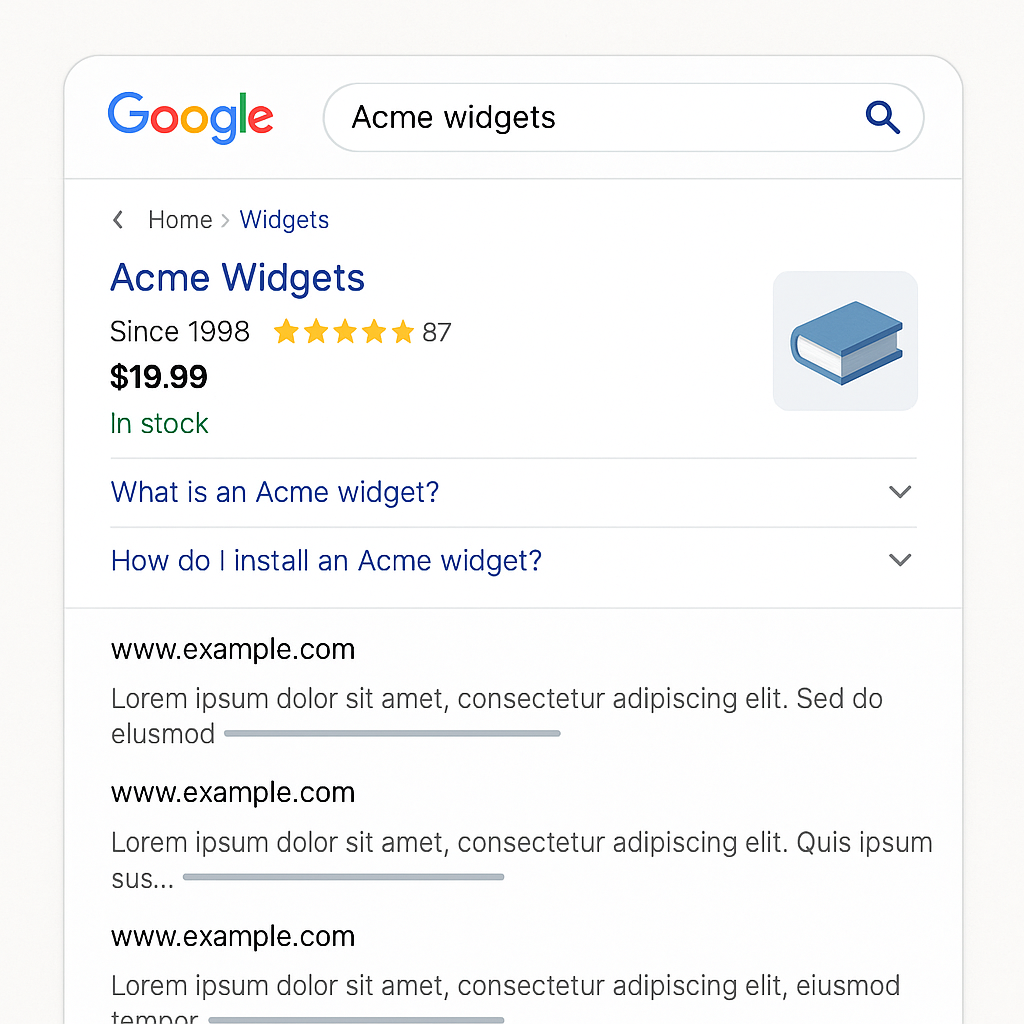
This mockup illustrates a typical rich result powered by still-supported structured data types. Notice the star ratings, price, stock status, breadcrumb, and expandable FAQs. Everything beneath it is a plain organic blue link result. That extra real estate and at-a-glance detail are exactly why structured data remains a high-ROI tactic, even as Google prunes rarely used formats.
Structured Data Types
Below is a grouped list of every structured data type that Google still supports. For each one you’ll see:
-
What the tag describes
-
Why a marketer might care
Skim the categories—content, shopping, local, jobs, and so on—to spot the data types that you might be able to use on your website.
| Type | Purpose (What it describes) | Marketing / SEO Value | Status (June 2025) |
|---|---|---|---|
| Core Content & Publishing | |||
| Article / NewsArticle | Headlines, dates, author of news or blog posts | Can surface in Top Stories and show large thumbnails—boosting CTR for fresh thought-leadership pieces | Supported |
| BreadcrumbList | Hierarchy of pages | Replaces long URLs with clean paths, reinforcing topical relevance | Supported |
| Dataset | Research or open-data sets | Drives journalists and analysts to gated benchmark studies | Supported |
| DiscussionForumPosting | User-generated threads and replies | Highlights active community content in SERPs | Supported |
| Event | Dates, venue, ticket links | Puts “Attend” or “Register” CTAs directly in search results | Supported |
| FAQPage | Question-and-answer lists | Expands beneath your listing, doubling vertical real estate and pre-qualifying traffic | Supported |
| HowTo | Step-by-step tutorials | Shows collapsible steps or images—excellent for DIY or product-assembly guides | Supported |
| ImageMetadata | Copyright & creator info on images | Protects brand imagery and encourages licensed reuse with attribution | Supported |
| ProfilePage | Details about a person or organization’s profile | Feeds Perspectives filter, boosting authority for leaders or spokespeople | Supported |
| QAPage | Single question with community answers | May win extra SERP slots for support-forum content | Supported |
| Recipe | Cook time, calories, ratings | Appears in recipe carousels with mouth-watering thumbnails | Supported |
| ReviewSnippet | Aggregated ratings & count | Star ratings attract eyes and trust—proven CTR lift | Supported |
| Speakable | Text suitable for voice assistants | Extends news reach to smart speakers | Supported |
| SubscriptionContent | Marks paywalled sections | Avoids cloaking penalties while ranking teaser copy | Supported |
| VideoObject | Video details, duration, key moments | Enables video previews and “chapters,” boosting watch intent and clicks | Supported |
| Carousel (ItemList) | Groups several items from one site into a swipeable gallery. | Owns more mobile SERP real estate and keeps users in your content cluster (recipes, products, articles). | Supported |
| Course | Lists title, provider, description, and price of an online course. | Puts e-learning or certification offers into a dedicated “Courses” pack—extra visibility without paid ads. | Supported |
| Education Q&A | Marks study-question pages so Google can show flash-card style answers. | Ed-tech brands surface interactive learning units that drive qualified student traffic. | Supported |
| Practice Problem | Adds quiz-style problem statements with step-by-step solutions. | Increases engagement for publishers offering test prep or skill assessments. | Supported |
| Math Solver | Shows detailed solution steps for math problems. | Great for tutoring or calculator tools—captures highly specific search intent. | Supported |
| Movie | Displays film titles, posters, ratings in a horizontal scroll. | Studios and review sites gain discovery for new releases beyond branded queries. | Supported |
| Software Application | Highlights an app with icon, rating, price, and install link. | Boosts organic installs for SaaS or mobile apps without relying solely on app-store ads. | Supported |
| Commerce & Shopping | |||
| Product + Offer | Name, price, availability, condition | Shows price, ratings and stock badges—major CTR driver for e-commerce | Supported |
| MerchantListing | Feeds free listings in Shopping tab | Earns visibility similar to paid PLAs without ad spend | Supported |
| Variants | Groups size/colour SKUs | Avoids cannibalisation; lets shoppers pick options in one card | Supported |
| LoyaltyProgram | Displays member pricing/points | Promotes sign-ups and repeat purchases | Supported (New) |
| MerchantReturnPolicy | Return window & refund terms | Builds shopper trust by surfacing hassle-free returns | Supported |
| VacationRental | Property details & availability | Competes with OTAs for direct bookings | Supported |
| Jobs & Local | |||
| EmployerAggregateRating | Company rating in job listings | Strengthens employer brand to attract talent | Supported |
| JobPosting | Job title, salary, location | Feeds Google Jobs—free applicant flow | Supported |
| LocalBusiness | Hours, address, booking actions | Improves map visibility and drives calls/visits | Supported |
| Organization & Infrastructure | |||
| Organization | Logo, legal name, social links | Builds authoritative Knowledge Graph entity for brand queries | Supported |
Why Did Google Retire These Seven Types?
Google says the decision is part of an ongoing effort to “streamline” results and focus engineering resources on features that deliver clear user value. Data collected from the Rich Results (structured data) ecosystem showed minimal publisher adoption of the seven markups and comparatively low end-user engagement, so maintaining these data types no longer made sense.
Importantly, pages that keep the deprecated code will not be penalized—they simply won’t trigger those visual enhancements anymore. Google has also stressed that the change allows its teams to iterate faster on more widely-used data such as Product, Article and FAQ, which continue to power billions of impressions every day.
In short, Google isn’t abandoning structured data—it is doubling down on the data that helps searchers evaluate content quickly. This increases the need for marketers to use structured data more often in their search marketing strategies.
Structured Data 101—A Plain-English Primer
Structured data relies on a shared set of labels—essentially an agreed-upon tagging system defined at Schema.org—that tells Google exactly what each piece of information on a page represents. By wrapping a product price in the “price” label or a blog headline in “headline,” you’re giving search engines an unmistakable, machine-readable piece of information on what to do with that data: this number is the price, this line is the title.
To check your structured data work, you can paste a URL into Google's Rich Results Test or the Schema Markup Validator—both tools flag missing properties and preview eligible SERP enhancements before anything goes live.
How to Implement Structured Data in 2025
A practical structured data roll-out starts with a content audit. Identify page types you publish regularly—products, how-to guides, events, job listings, long-form articles—and map each to a currently supported structured data type. For example, product pages benefit from the Product and Offer data types; knowledge-base articles often qualify for the FAQPage data type; and any video asset can utilize the VideoObject data type.
Implementation itself is straightforward once you pick an approach:
- Hard-coded JSON-LD is the gold standard for performance and control. Developers paste the script directly into templates, usually pulling values from your CMS fields.
- CMS plug-ins (such as Yoast, Rank Math, and Shopify’s SEO apps) automatically generate schema for non-technical teams.
- Tag Management or server-side renderers fill gaps where direct code edits are difficult, inserting JSON-LD via data layers.
After deployment, validation really must be done. Run the website page that contains the new structured data through either the Google or schema.org testing tools, fix warnings, and then monitor your Google Search Console’s “enhancements” reports to watch for the results that come from your effort, or spot errors before they snowball. Keep a changelog so future site updates don’t silently break your markup.
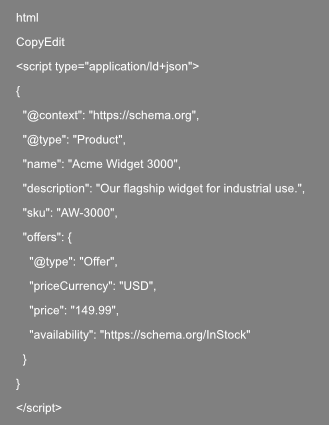
A quick code example shows how succinctly a structured data schema can be:
The Strategic Value of Structured Data
Structured data will not catapult a page from position 30 to page one by itself, but it does amplify whatever organic visibility you already have:
- Higher click-through rates (CTRs). Case studies have shown uplifts as high as 30% when rich snippets display versus plain blue links.
- Entity clarity fuels the Knowledge Graph and SGE. According to Search Engine Land, Google fully understands your brand, products, and content relationships, you become eligible for knowledge panels, Perspectives carousels, and AI summaries—features that siphon traffic away from less-structured competitors.
- Better user intent matching. Schema improves ranking signals indirectly by telling Google exactly what a page offers, reducing bounce-inducing mismatches.
- Data to prove ROI. Google’s Search Console breaks out impressions, clicks, and average position for each structured data result type, so you can quantify performance and attribute wins to your markup work.
Google has a case study on the MX Player site. According to this case study, after adding the VideoObject structured data schema, organic traffic increased by a factor of three and video page views doubled.Action Plan for Marketers Post-Elimination
- Audit now: Run the Rich Results Test on a sampling of URLs. If any of the seven retired types appear, schedule their removal or replacement.
- Switch to evergreen schema: Replace SpecialAnnouncement with Article plus clear headline and date, or substitute ClaimReview with a standard Article + Review block if fact-checking is core to your content.
- Prioritize high-impact pages: Start with templates that influence revenue—product detail, services, resource hub articles—before tackling edge-case content.
- Upskill your team: Host a brown-bag session to demystify JSON-LD, walk through Search Console reports and share success metrics.
- Stay subscribed: Follow the Search Central blog and trusted SEO news outlets like Search Engine Land or Search Engine Journal so future changes never blindside you.
- Ongoing Review: Download our Structured Data Implementation checklist.
Conclusion
Google’s decision to prune a handful of under-used structured data types is not a signal that structured data is fading. On the contrary, it spotlights how crucial well-structured pages are to an AI-driven search ecosystem that prizes clarity and efficiency. By investing a few development cycles in evergreen code markup today, you set your site up for richer presentations, measurable CTR lifts and durable visibility across emerging Google surfaces.
Run that audit, adjust your structured data markup, and watch the enhanced listings—and the qualified traffic—follow.
To help with getting your website up-to-date on structured data, we've created a Structured Data Implementation checklist that you can download for free!