With the speed of change within social media platforms, having a strategy for using the various social media platforms within your marketing efforts is vital for success.
Consider that in 2023 TikTok will become the third social media platform to surpass 100 million users in the US, according to eMarketer.
The photo-sharing app BeReal which was invented in 2020 and started to gain traction in 2022, saw downloads of their app last year skyrocket to a remarkable 315% growth over the year, according to Social Media Today.
Let's not forget about Instagram. According to a Hubspot survey, 25% of marketers surveyed said they expect Instagram to grow the most this year.
And it's not just about new social media platforms. The way marketers use various social media platforms is changing rapidly as well.
Companies quickly find social media platforms a large opportunity to expand their customer service initiatives. Using social media platforms to address customer concerns increases customer satisfaction, with 44% of consumers having a more favorable view of companies that respond via social media.
Social commerce, first getting recognized in 2020, will continue its growth, offering companies yet another platform that allows their customers the ability to research and purchase products, with 80% of company executives saying they will be selling products and services via social media channels within the next three years.
Although social listening has been around for years, more companies realize the true potential of this strategy for social media. By initiating a social listening effort, you can "listen" across multiple social media channels for conversations that include key-phrases important to your company.
Social Media Strategy
A social media strategy is about more than just what to post, how often to post, or whether or not to include pictures in your post. Social media is far too important to your brand to use it just for posting.
Having said that, it's important to note that a social media strategy means different things to different companies. As we discussed earlier, there are several new strategies that are rising up to bring more value to a company's social media efforts.
Social media is integrated into some companies' sales, marketing, and thought leadership efforts.
For some companies, social media is used more for customer loyalty, customer retention, and an overall customer communications vehicle.
While still, other companies are adopting a social media strategy that will drastically improve the quality and speed of their customer service initiatives.
How you determine to use social media for your business, it's essential that you begin by creating a social media strategy that is perfect for your company and your customer's needs, then commit that strategy to paper to ensure a well-executed plan that will help you grow your business.
Start With A Framework
By using a framework for developing your social media strategy, you'll be better positioned to take your strategy from planning to execution and review. This will ensure that your plan is being executed correctly, and the review will ensure that your efforts are accomplishing your goals for using social media.
Additionally, a strategic framework will provide your company with a repeatable effort that provides a fine-tuned result for years, releasing you from the continual scramble trying to figure out what to do with social media.
Here's a framework to help you write your strategy and execute and measure the results.
Current Situation
Regardless of the goal, assessing where you are starting from is critical to success. This first step in the framework requires that you take a deep dive into where your company currently stands when it comes to how you're using social media platforms. Are you just posting general information every week with little planning behind it? Or are your social media efforts part of your larger digital marketing strategy?
When evaluating the current situation of your social media efforts, one of the first areas to evaluate is the content that you have available for social media communications. Do you have a library of content that will sustain a couple of months of social media communications, or are you scrambling to assemble content as needed?
What are your competitors doing on the various social media channels? What channels are they on? Do you know the type of engagement that they are getting with their social media efforts? You can use several tools to measure what your competition is doing. Using one of these tools will help you monitor what is happening and what is getting good play.
Once you have a solid idea of what content you currently have and you've taken a look at what your competition is doing and what is working for them, it's time to assemble a list of what you will need in terms of content, tools and possibly even social media accounts, to begin building your social media plan.
Who Are You Talking To
It's impossible to read a marketing article that isn't talking about the importance of personalization. In fact, we've got a great article on the importance of personalization on our website. Before you can use personalization in your digital marketing strategy (or any marketing strategy, for that matter), you have to have a very precise understanding of who you're talking to.
One of social media's most significant advantages is its ability to deliver precise audiences. A marketer's job is to identify who that audience is and then create content that is highly targeted to that audience.
An important component of your social media strategy is identifying the different audiences and audience members you want your social media efforts to reach. For example, if you are a B2C company selling running shoes, your different audiences could be casual and dedicated runners. Then within each of those two categories, you will likely have sub-categories such as various runners' ages, people with different design appeal, shoes for people that run in all weather, and/or people that only run indoors.
As you can see, each of these audience sub-categories of people will be interested in your company's different products and services. To get your brand to be heard through all the noise, it will be critical to have communication assets (content, imagery, product information, etc.) that will be highly relevant for each audience sub-category. This will make your social media marketing extremely personal, increasing your audience's engagement with your social media communications.
Part of the communication plan that only some companies think about is their brand voice. A brand voice is communications that give your brand your distance personality and must be used in all marketing communications to build consistency. As an example, if your company sells streetwear clothing, your brand voice will most likely be more urban and will utilize much more slang than a company that sells, for example, workwear.
86% of consumers say that authenticity is a key factor when they decide who to do business with. Ensure your brand voice is authentic to your company's vision and mission.
When you create your brand voice, start with the different personas (as outlined above) to gain insights into the type of brand voice they would respond to. Think about the other types of content they will consume and use that as a guide to what qualities your brand voice should adopt to attract your audiences.
According to Hubspot, you'll know you've hit it when a potential customer feels you are talking directly to them. When your customers feel you're talking directly to them, they will feel part of the conversation.
Where Do You Want To Be
Now that you've identified where you are, the assets that you have, and who your audience is, it is time to determine exactly where you want to be in terms of your social media marketing efforts.
This part of your strategy will look a lot like the annual goal-setting you do for your business, only this time; you'll be specifically focused on your social media marketing efforts.
Start with setting SMART goals for your social media marketing. We've written a blog post on using SMART goals for an overall digital marketing strategy, and the steps for a social media strategy will be the same.
Once you've figured out exactly what you want to accomplish, the next step is to determine exactly how you will measure the result to determine if you're achieving your goals.
These measurements are referred to as Key Performance Indicators or KPIs. It's important to remember that every business will have different KPIs based on their goals for social media marketing. However, below you will find a few common KPIs that may work for you:
Reach: This KPI is often confused with impressions, so let's clarify this. Reach is the total number of unique people who see the content you share on social media platforms. Impressions are the number of times your content is displayed.
To better understand the difference, let's use this scenario: if you posted a tweet that showed up in all 100 of your follower's feeds, that would be a reach of 100. If you posted 2 tweets that showed up, again, in all of your 100 followers' feeds, that also would be a reach of 100.
The difference would be that the 2 tweets showing up in your 100 follower's feeds would be 200 impressions.
Engagement: Your followers are viewing hundreds of posts in their feeds on a regular basis, but not everything that shows up in their feed has them engaging. There are multiple metrics that make up engagement; clicks, likes, shares, and mentions.
Clicks, obviously, are when someone clicks on your social media post. Likes, again, obviously are when someone "likes" your post. Shares, some will argue are the most important engagement, are when someone shares your post with their followers. Comments are when someone feels the need to comment on your post. Finally, mentions are when someone mentions you or your company in their social media post.
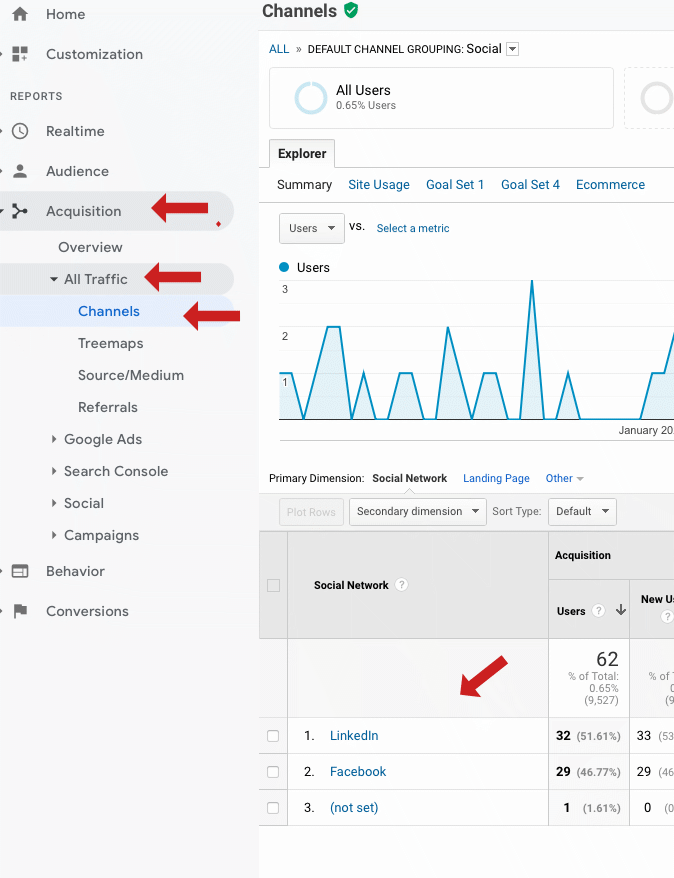 Conversions: All of the work that you're doing on social media is for nothing if it doesn't turn people into customers. To measure the results of your social media effort, you'll want to bring Google Analytics (GA) into your social media marketing metrics. With GA, you can track the number of people coming to your website from your social media accounts.
To get this information from your GA account, you'll navigate to the Acquisition area, click on Overview. Here you'll see different categories from where your website traffic is coming. One of the sources of traffic is labeled "Social". Click on that link to see a breakdown of the social media platforms sending traffic to your website. This will give you a good idea of the conversions you're getting from your social media efforts.
How Will You Get Where You Want To Be
Now that you know where you're going and how to measure your progress, it's time to determine how you will get there. This is an essential element of your social media marketing strategy.
Focus is more important than defused. A focused social media effort will zero in on 2-3 channels that make the most sense for the audience that you're trying to reach. Then, once you've identified the top platforms, write the highest quality content for those platforms as consistently as you can. Pouring poor-quality content across a bunch of platforms will never perform in a manner that will positively impact your business.
To help you decide what social media channels, or platforms, will represent the best chance to find your audience, here's an overview of some of the most popular platforms and the types of users that they have:
Facebook is a platform whose users are primarily "consumers" by nature and extremely local. If your business is a B2C and serves a predominantly local customer, then Facebook is an excellent platform to try out for your business.
Twitter is an excellent platform to build your brand and discover what your audience is discussing. On Twitter, you can build your brand voice, share thought leadership, and use the platform to drive people to your website.
Pinterest is viewed as more of a "scrapbooking" platform or photo sharing. If your business lends itself to a lot of photography (i.e. interior design), then Pinterest could be an excellent platform for you. Pinterest's users are predominantly female, whose interests lean toward DIY crafts and lifestyle interests.
YouTube has become one of the most significant search engines on the Internet. The vast majority of searches on YouTube are "how to" searches. If you have a complex product that you are marketing or if you're in a service industry, you can use YouTube to educate your prospective new customers via YouTube videos.
LinkedIn is "the" platform for business. Consequently, you'll find the oldest demographic of users on LinkedIn. If you're marketing as a B2B company or trying to get the attention of business people, LinkedIn is definitely a platform you want to pay attention to.
There are obviously more social media platforms, but for the purpose of this article, this will give you an idea of how to select a couple of platforms to get started on.
Conclusion
Social media marketing without a strategy is pure chaos. Keep your company from falling into the trap of trying to wing it when it comes to your social media marketing; the stakes are just too high. If you need more information or help to develop your framework for social media marketing, feel free to reach out, we'll always answer your questions.