In today’s competitive business environment, marketing success requires delivering the right message to the right audience at the right time.
Customers no longer make purchase decisions solely based on price or product features; instead, they seek brands that understand their needs and offer tailored solutions. The sales funnel, also known as the customer journey, provides a structured framework for understanding the distinct stages customers go through before and during their decision to purchase. By mapping the stages, awareness, consideration, and decision, businesses can better anticipate customer needs and design campaigns that resonate at each phase.
Aligning marketing campaigns with these stages increases engagement and builds trust and loyalty, fostering stronger relationships with potential customers. This alignment ensures that your business delivers relevant and meaningful messages, avoiding the pitfalls of generic or poorly timed communications.
Ultimately, a strategy grounded in the buying funnel helps businesses maximize the effectiveness of their marketing efforts, driving higher conversions, customer satisfaction, and long-term growth.
Targeted Communication for Specific Needs
The first step in developing a marketing strategy based on the buyer’s position in the sales funnel is identifying the stages of your customer’s buying funnel and clearly defining each stage in terms of what the buyer is looking for and what type of marketing messaging would be the most relevant to them.
Though every industry can vary the stages of the buying process, the most common stages are awareness, consideration, and decision. Your potential customers have unique needs during each stage, and your marketing messaging should be tailored to what they are looking for.
Awareness Stage:
- Description: In the awareness stage, the buyer first recognizes a need or problem. They may not yet know about your brand, product, or service, so the focus is on visibility and education. Buyers often conduct initial research to understand their problems and potential solutions better, making this stage critical for establishing your brand as a credible and trustworthy resource.
- Objective: When your potential customer is in this stage of their decision-making, you want to be able to introduce them to your brand and/or your company’s products or solutions.
- Marketing Focus: Build brand recognition through broad-reach efforts like social media, display ads, SEO-optimized content, and educational materials.
Consideration Stage
- Description: At this stage, buyers actively compare the solutions uncovered by their research during the awareness stage. They’ve moved beyond identifying their need for general solution information and are now considering specific solutions and companies. This is a critical point for highlighting your brand’s unique value proposition and helping these buyers understand why and how your solution stands out from the competition.
- Objective: At this stage of the buyer’s journey, you want your marketing to engage and educate buyers as they evaluate their options.
- Marketing Focus: Provide detailed information, such as comparison guides, customer testimonials, whitepapers, and webinars, to help buyers make an informed decision.
Decision Stage
- Description: In the decision stage, buyers have fleshed out all of the information and options they have accumulated and are now ready to make a purchase. They’ve narrowed their choices and are looking to make the final decision on what company and product or service is the best fit for their situation. At this point, buyers seek reassurance, value, and clarity. Your goal at this point is to minimize friction in the purchase process and address any remaining objections or doubts.
- Objective: Convert leads into customers.
- Marketing Focus: Emphasize trust-building and urgency through limited-time offers, personalized follow-ups, testimonials, and easy-to-navigate checkout processes or conversion forms.
Aligning campaigns with the unique needs of each stage of the buying funnel ensures relevancy and improves the likelihood of engagement and conversion.
Efficient Resource Allocation
Businesses can optimize their marketing spend by tailoring their campaigns to the specific needs of each funnel stage. Rather than taking a one-size-fits-all approach, this strategy allows for precise allocation of resources and messaging that align with the audience’s position in their buying journey.
Awareness Stage:
In the awareness stage, resources are best spent on broad-reach strategies that create visibility and spark curiosity among potential customers who may not yet recognize your brand or their need for your solution. Broad-reach display ads can target specific demographics or interests to ensure your message reaches those most likely to engage.
Additionally, investing in top-of-funnel content such as educational blog posts, videos, or infographics helps establish your brand as an authoritative source, setting the stage for deeper engagement in later stages.
Consideration Stage:
Customers in the consideration stage evaluate their options and seek information to guide their decision-making process. Allocating resources to retargeting ads is crucial here, as it allows you to reconnect with individuals who have previously interacted with your brand.
Incorporating detailed product comparisons, case studies, or customer reviews into these ads provides concrete evidence of your product’s value. Further, enhancing your website's user experience with features like downloadable guides or interactive product demos ensures prospects can easily find the information they need.
Decision Stage:
The decision stage is where prospects are ready to take action, but small barriers or unanswered questions may still prevent them from converting. Allocating resources to personalized marketing tactics, such as dynamic email campaigns or custom landing pages, helps address these final hurdles.
For instance, abandoned cart emails with special discounts or free shipping offers can nudge hesitant buyers to complete their purchases. Additionally, investing in high-quality customer support tools, like live chat, ensures prospects can resolve concerns in real-time, increasing the likelihood of conversion.
This strategic alignment reduces wasted effort and maximizes ROI.
Enhanced Customer Experience
Aligning marketing campaigns with the buying funnel enhances the customer experience by ensuring that interactions are tailored to their specific needs and expectations at each stage of their journey. This strategic approach reduces friction, confusion, and irrelevant messaging, fostering a more intuitive and satisfying experience. Here's how the customer experience is elevated at each funnel stage:
Awareness Stage: Building Trust Through Education
For first-time visitors just discovering your brand, the focus should be on educating and informing rather than selling. Customers at this stage are exploring potential solutions and are unlikely to respond well to aggressive sales tactics.
Enhanced Experience:
- They will be more likely to engage with your company when they are presented with high-value, educational content such as blogs, infographics, or explainer videos that address their challenges or interests.
- At this stage, marketing messaging should focus on raising awareness and establishing your brand as a credible, trustworthy resource.
Result: A positive first impression and an initial connection that sets the stage for further engagement.
Consideration Stage: Empowering Informed Decisions
Customers in this stage are evaluating options and comparing your offerings against competitors. They need detailed information to make informed decisions.
Enhanced Experience:
- They should be able to receive access to product comparisons, case studies, testimonials, or FAQs that directly address their questions and concerns.
- Retargeting campaigns that remind them of the resources they previously explored will help to keep your brand at the top of their mind without being intrusive.
Result: A feeling of being supported in their decision-making process, which builds confidence in your brand.
Decision Stage: Reducing Barriers to Conversion
Customers are ready to purchase at this point in their buying journey but often may need reassurance or an extra nudge to take the final step.
Enhanced Experience:
- Personalized offers, such as discounts, free trials, or demo invitations, can help reduce any remaining hesitation and persuade them to make the final decision.
- A simplified checkout process or one-on-one consultations ensure a smooth and frictionless conversion experience.
Result: Customers feel understood and valued, making them more likely to complete their purchase and trust your brand for future needs.
Improved Campaign Metrics and Insights
To ensure the success of campaigns tailored to each stage of the buying funnel, it’s critical to measure their performance effectively.
Google Analytics 4 (GA4) provides robust tools and customizable reports that will allow you to evaluate your efforts at every stage of the funnel. This actionable guide breaks down how to use GA4’s features to set up tracking, analyze performance, and refine strategies for each funnel stage.
Awareness Stage: Tracking Visibility and Reach
Key Objective: Assess how well each of your campaigns generates brand awareness and attracts new visitors.
Reports to Use and Navigation Paths:
- Traffic Acquisition Report:
- Path: Reports > Acquisition > Traffic Acquisition
- Key Metrics: New Users, Sessions by Source/Medium, Traffic Channels.
- Actionable Tip: Use UTM-tagged links to identify the performance of specific campaigns.
 Engagement Report:
- Path: Reports > Engagement > Events
- Key Metrics: Event Count (e.g., video plays, blog reads), Session Engagement Rate.
- Actionable Tip: Track engagement metrics for top-of-funnel content like blog views or video interactions.
- Audience Report:
- Path: Reports > Engagement > First Visit
- Key Metrics: Growth in first-time user segments.
- Actionable Tip: Monitor demographic segments to understand the reach of your awareness campaigns.
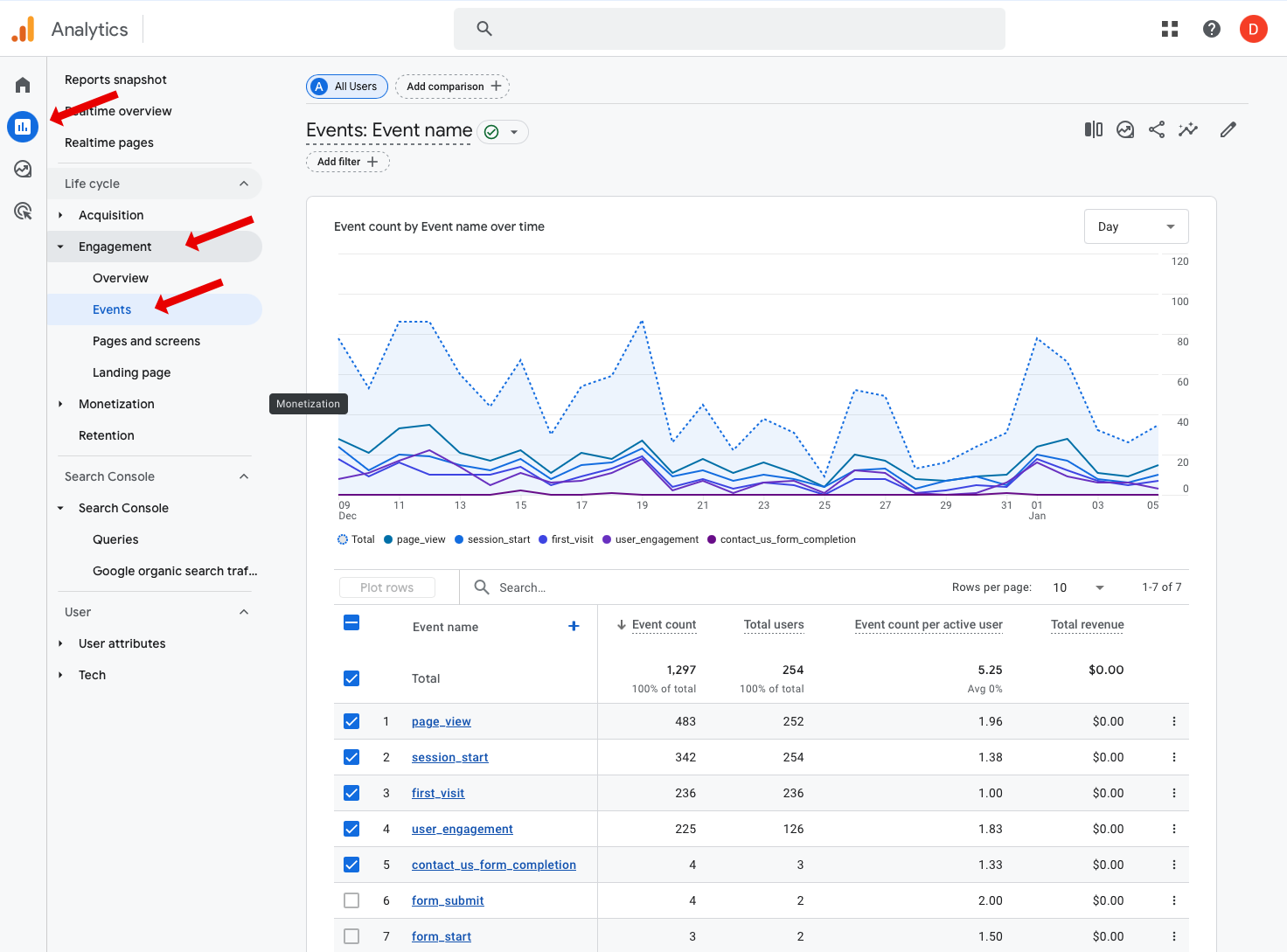
Setup Tip: To track campaign performance, create events for actions such asog clicks, or social media referrals video plays, bl.
Consideration Stage: Evaluating Engagement and Interest
Key Objective: Measure how effectively campaigns engage potential customers and encourage exploration.
Reports to Use and Navigation Paths:
- Engagement Report:
- Path: Reports > Engagement > Events
- Key Metrics: Scroll Depth, Interaction Events (e.g., resource downloads, form views).
- Actionable Tip: Track detailed interactions with middle-of-funnel content, like whitepapers or product pages.
- Landing Page Report:
- Path: Reports > Engagement > Pages and Screens
- Key Metrics: Page Views, Average Time on Page by Landing Page.
- Actionable Tip: Identify high-performing content and optimize underperforming pages.
- Explorations (Path Exploration):
- Path: Explore > Path Exploration
- Key Metrics: User navigation paths, and drop-off points.
- Actionable Tip: Visualize how users move through your site and identify where they drop off.
Setup Tip: Define custom events for resource downloads or form submissions to track engagement effectively.
Decision Stage: Monitoring Conversions and Transactions
Key Objective: Track how effectively your campaigns drive conversions and purchases.
Reports to Use and Navigation Paths:
- Conversions Report:
- Path: Reports > Engagement > Conversions
- Key Metrics: Conversion Events, Conversion Rate, Conversion Value.
- Actionable Tip: Use this report to monitor how well campaigns drive key actions like purchases or demo requests.
- E-commerce Purchases Report (if applicable):
- Path: Reports > Monetization > E-commerce Purchases
- Key Metrics: Purchase Revenue, Cart Abandonment Rate.
- Actionable Tip: Track e-commerce metrics to evaluate decision-stage campaign performance.
- Attribution Report:
- Path: Advertising > Attribution > Conversion Paths
- Key Metrics: Assisted Conversions, First Interaction vs. Last Interaction Attribution.
- Actionable Tip: Analyze the role of different channels in driving conversions.
Setup Tip: Configure conversions in GA4, such as form completions, purchases, or consultation bookings, and assign values to prioritize high-impact actions.
Implementation Steps to Optimize GA4 for Funnel Tracking
Define Events for Each Stage:
- Identify key actions for each stage (e.g., video views, form submissions, purchases) and set them as custom events in GA4.
Create Funnels in Explorations:
- Use the Funnel Exploration feature to visualize user progress through the stages and identify drop-off points.
Set Up Custom Audiences:
- Segment users by behavior, such as first-time visitors, engaged prospects, or repeat customers, to better understand performance by audience type.
Use Conversion Paths and Attribution Models:
- Analyze how different channels and campaigns contribute to conversions, ensuring credit is appropriately assigned.
Automate Reports:
- Create custom dashboards in GA4 or integrate with Google Looker Studio to automate reporting and monitor funnel performance regularly.
By leveraging these GA4 reports and features, you can gain actionable insights into the effectiveness of your campaigns at each funnel stage. This allows you to make data-driven adjustments, optimize marketing spend, and continuously improve the customer journey.
5. Building a Holistic Marketing Strategy
The buying funnel provides a cohesive framework that ensures all marketing activities are interconnected and serve a unified goal. Instead of siloed efforts, campaigns work together to guide consumers seamlessly through their journey. For example:
- Social media campaigns at the awareness stage may feed into email nurturing campaigns during the consideration stage.
- On-site interactions can be leveraged for retargeting ads designed for decision-making.
This integration fosters brand consistency and helps maintain momentum as customers progress through the funnel.
Conclusion
Effectively measuring the success of your campaigns across the buying funnel is not just a matter of evaluating performance—it’s about understanding your audience, refining your strategies, and optimizing your marketing spend for maximum impact.
By aligning campaigns with each stage of the funnel—awareness, consideration, decision, and post-purchase—you ensure that your messaging and resources are tailored to meet your customers' needs at every step of their journey.
Google Analytics 4 (GA4) offers powerful tools to help you accomplish this. From tracking new user acquisition in the awareness stage to analyzing retention and lifetime value post-purchase, GA4’s event-based tracking and customizable reports provide the insights needed to refine your campaigns.
By leveraging its features, such as event tracking, funnel explorations, and attribution models, you can transform raw data into actionable strategies that drive conversions and foster long-term customer loyalty.
The real value of this approach lies in its ability to make data-driven decisions that improve customer experience and business outcomes. By measuring and analyzing each stage of the funnel, you can identify what’s working and continuously improve your marketing efforts. This enhances the efficiency of your campaigns and strengthens your relationship with your customers, positioning your brand as a trusted partner throughout their journey.
In a digital landscape where personalization and relevancy are key, aligning your campaigns with the buying funnel and using tools like GA4 to measure results is essential for staying competitive. By implementing the strategies and techniques outlined in this article, you’ll be well-equipped to create a seamless, impactful customer journey that drives sustainable growth and lasting success.